
Strategic Analysis: The Transformative Impact of AI in 2026

The 2026 Strategic Mandate: Shifting from AI Hype to Measurable Value
The year 2026 marks a pivotal inflection point in the enterprise adoption of artificial intelligence. The era of speculative, bottom-up experimentation is rapidly concluding, replaced by a disciplined, top-down strategic mandate: AI must deliver tangible, measurable business value. As organizations move past the initial hype, leadership is demanding demonstrable return on investment (ROI), shifting the focus from technological possibility to operational and financial impact. This transition is not a retreat from ambition but a maturation of strategy, where AI becomes a core driver of competitive advantage rather than a collection of disconnected science projects.
A clear expert consensus is forming that a significant "reality check is coming" for AI in 2026. According to Luis Blando of OutSystems, the market is moving past "trillion-dollar dreams built on fragile revenue streams," with real impact emerging from agentic systems that solve "existing, high-value business problems." This view is reinforced by PwC, which finds that crowdsourcing AI initiatives "seldom produces meaningful business outcomes" and advises that leadership must instead "pick the spots" for focused, strategic investment. Forrester concurs, predicting that 2026 will be a year of "hard hat work" focused on the unglamorous but essential tasks of restructuring and preparation, not overnight transformation. This pragmatic shift is further illustrated by Gartner's analysis that Generative AI is now entering the "Trough of Disillusionment," a phase characterized by a move toward more practical, grounded applications.
This mandate for value is colliding with stark economic realities defined by the tension between executive ambition and investor patience. A Teneo survey reveals that 68% of CEOs plan to increase their AI investment in 2026, with 88% believing AI is critical for navigating business disruption. However, the same survey highlights a stark reality: fewer than half of current AI projects are ROI-positive. This gap has created what Teneo's Ursula Burns describes as "AI ROI tensions," as investors become "increasingly impatient for ROI." The disconnect is stark: 53% of investors expect to see a return on AI investments in six months or less, while 84% of large-cap CEOs predict it will take longer.
This pressure to deliver concrete returns is forcing a strategic pivot, steering investment toward the specific technological advancements capable of generating that value.
The Evolving AI Arsenal: Agentic Systems, Specialization, and Infrastructure
Mastering the next generation of AI technology requires a fundamental shift in capital allocation—away from monolithic models and toward a diversified, resilient arsenal of agentic, specialized, and data-centric systems. The general-purpose models that captured the public's imagination are giving way to purpose-built tools. For enterprise leaders, deconstructing this arsenal is the critical foundation for building a sustainable competitive advantage.
The Rise of Agentic AI
The next frontier of AI is decidedly "agentic"—a class of systems that operate with defined goals, interpret data contextually, and take action autonomously, moving far beyond simple task automation. These intelligent agents are poised to redefine the core logic of business operations.
Redefining Customer Experience: Agent-to-agent interactions will begin to coordinate complex services "without human initiation," creating seamless experiences where customer needs are anticipated and met behind the scenes, according to Nate Barad of Algolia.
Transforming Workflows: Raju Malhotra from Certinia predicts that agentic AI will take over high-volume, standardized processes such as project planning, resource allocation, and contract compliance. This will liberate human workers from repetitive tasks, allowing them to focus on higher-value advisory and client engagement roles.
Creating Self-Generating Intelligence: Looking further ahead, the most advanced agentic systems will evolve into what Dustin Snell of Automation Anywhere describes as "real-time, auto-generated intelligence software," dynamically creating user interfaces and adapting workflows to changing user intent.
The true strategic differentiator in this new landscape will be orchestration. As Philip Miller of Progress Software notes, "having more agents doesn’t matter. What matters is getting them to actually work together." In this model, humans will transition from being prompt writers to becoming "managers of agents," guiding and coordinating autonomous teams to achieve business outcomes.
The Pivot to Specialization
In 2026, the AI conversation is decisively moving away from the notion of a single "best model." As Luis Blando of OutSystems predicts, AI development will be "all about specialization instead of general-purpose use cases." This pivot is creating a new ecosystem of tailored, high-performance AI solutions.
Vertical AI: These are models trained on industry-specific language, workflows, and data, enabling them to solve complex problems that generic AI struggles with. Jason Roberson of Dassault Systèmes predicts that Vertical SaaS platforms, powered by this specialized AI, will "outpace horizontal platforms" in 2026 as domain knowledge becomes a key performance driver.
Hybrid Model Ecosystems: Organizations are increasingly building hybrid systems that blend the complex reasoning capabilities of Large Language Models (LLMs) with the efficiency and privacy of Small Language Models (SLMs). Experts from Valiantys and OutSystems foresee the convergence of SLMs, LLMs, and Model Context Protocols (MCPs) into blended, purpose-built AI stacks that can be tailored to specific departments and regulatory requirements.
Domain-Specific Language Models (DSLMs): According to Gartner, DSLMs are emerging to fill the critical gap left by generic LLMs. By training on specialized data, they provide higher accuracy, better compliance, and greater reliability for targeted business functions in fields like finance, healthcare, and law.
Foundational Imperatives: Data and Compute
These advanced AI systems are only as powerful as the foundation they are built on. As Nate Barad of Algolia states, "AI isn’t the story anymore; it’s table stakes. The real differentiator in 2026 is data quality and domain-specific intelligence." The strategic focus is shifting upstream to "First-Mile Data"—the "messy, inconsistent information arriving from customers, partners, brokers, and legacy systems," which Jason Roberson of Dassault Systèmes identifies as AI's real leverage point. Normalizing and enriching this data before it reaches AI workflows is becoming a top enterprise priority. Concurrently, the underlying hardware continues to evolve, with TrendForce noting that advancements in High Bandwidth Memory (HBM) and optical communications are redefining AI cluster architectures to overcome critical data bottlenecks.
These technological shifts directly dictate the new logic of the human-machine enterprise.
The Human-Machine Enterprise: Redefining Work, Roles, and Business Models
The adoption of agentic and specialized AI is fundamentally reshaping the organization, causing AI to function "more like part of the workforce rather than a tool." This paradigm shift mandates a complete reinvention of management, talent, and productivity models, forcing enterprises to rethink the relationship between human capital and intelligent machines.
The Evolution of Roles and Skills
As AI takes on more cognitive labor, human roles are elevating from execution to orchestration. This transformation is particularly acute in technical fields but is rippling across the entire organization.
Sammy Ahmed of name.com predicts a radical shift for software developers, forecasting that more than 75% will be "architecting, governing, and orchestrating instead of building applications." Many will evolve into "cognitive architects" who design blueprints for how AI systems should think and solve complex business problems.
The concept of the "100x employee" is emerging, defined by Sendbird CEO John Kim as individuals who orchestrate entire AI workforces to accomplish the work of whole departments. To quantify their impact, Kim proposes a radical new productivity metric: measuring success by "AI token consumption."
This evolution makes workforce upskilling a non-negotiable imperative. According to a Teneo survey, CEOs are prioritizing AI augmentation (50%) and upskilling talent (46%) in 2026. Nate Barad of Algolia issues a stark warning: organizations that fail to provide essential AI training "will not survive."
These new roles are not merely an HR trend; they are the human capital infrastructure required to deliver on outcome-based commercial models, as they provide the orchestration capabilities necessary to guarantee results, not just effort.
AI's Impact on Business Models and Productivity
The integration of agentic AI is disrupting long-standing business models, shifting the value proposition from human effort to automated, outcome-driven results.
Addressing the Human Element: Fatigue and Trust
This rapid transformation is not without its challenges. Leaders must actively manage the human side of the AI revolution to ensure its success.
Danny Asnani of Forbes identifies a growing sense of "AI fatigue," urging leaders to balance innovation with humanity and use AI as an "enabler, not a replacement." Acknowledging that teams are weary of constant AI hype is the first step toward a more grounded, outcome-focused conversation.
Ironically, AI adoption can lead to increased employee workload. A survey cited by CSG found that 77% of employees using AI say it has increased their workload, often due to the need to manage, verify, and correct AI outputs. This highlights the need for leaders to provide clearer expectations and better-designed human-in-the-loop workflows.
In this environment, trust will become a "core driver of competitive advantage." Deirdre Leone of ContractPodAi notes that customers will increasingly expect "explainability-by-design" across every AI touchpoint, demanding transparency into how decisions are made.
This imperative for trust is not merely a branding exercise; it is an operational and governance challenge that demands a rigorous new approach to risk management.
Mastering the New Risk Frontier: Governance, Regulation, and Cybersecurity
Mastering the intersection of AI innovation and risk is the central governance challenge for the C-suite in 2026. Robust governance is no longer a supplementary function but a foundational pillar of any viable AI strategy. The increasing complexity of the global regulatory landscape, combined with the high-stakes consequences of system failure, means that operationalizing governance is now a prerequisite for sustainable AI-driven growth.
The Evolving Regulatory Landscape
The legal frameworks governing AI are maturing rapidly, creating a complex and fragmented compliance environment that demands proactive, strategic navigation.
The EU AI Act, a landmark piece of legislation, will see the bulk of its obligations take effect on August 2, 2026. This act establishes a comprehensive, risk-based compliance system that will have far-reaching implications for any company developing or deploying AI systems in Europe.
In the United States, the Colorado Artificial Intelligence Act (SB24-205) stands as the "nation’s first comprehensive statewide AI regulation bill," with an original effective date of February 1, 2026. It signals a trend toward state-level action that will require careful monitoring.
Gartner forecasts that the global AI landscape will fragment as "technical and geopolitical factors force organizations to localize solutions," predicting that by 2027, 35% of countries will be locked into region-specific AI platforms. This predicted fragmentation means a "one-size-fits-all" compliance strategy is unviable. Multinational enterprises must therefore architect their AI stacks for localization by design, treating regional compliance not as an afterthought but as a core system requirement.
The Imperative for Responsible AI (RAI)
In response to these pressures, 2026 is the year that companies must move Responsible AI (RAI) from principle to practice. PwC forecasts that organizations will "overcome this challenge and roll out repeatable, rigorous RAI practices." This shift is driven by the recognition that RAI is both a powerful risk mitigation tool and the primary mechanism for delivering on the promise of "explainability-by-design." A PwC survey confirms this dual benefit, finding that 60% of executives said RAI boosts ROI and efficiency.
An operational RAI framework must include several core components:
Treating AI like a new employee, with "structured onboarding, ongoing supervision, and defined accountability," as advised by Joel Burleson-Davis of Imprivata.
Establishing clear lines of responsibility for when AI systems make mistakes.
Integrating IT, risk, and AI specialists early in the development lifecycle and actively exploring new tech-enabled solutions for AI testing and monitoring, per PwC's guidance.
AI-Driven Cybersecurity Challenges and Solutions
The proliferation of AI also introduces a new class of cybersecurity risks, particularly from AI-generated code. Jim DeCarlo of Sonar notes that poor software quality will cost the U.S. more than "$2.41 trillion annually," with nearly two-thirds of that cost attributed to cyber-crime fueled by insecure code. AI code generation shifts the development bottleneck from creation to verification, demanding rigorous new governance and validation workflows to ensure that speed does not come at the expense of security. In response, Gartner identifies a trend toward "preemptive cybersecurity," where AI itself is used to power programmatic denial and deception tactics that act before attackers can strike, turning the technology into a defensive asset.
This strategic focus on risk and governance provides the necessary guardrails for AI's practical application across diverse and critical industries.
AI in Action: A Cross-Sector Analysis of Transformation
The strategic trends of value-driven adoption, technological specialization, and rigorous governance are not merely theoretical; they are actively reshaping key global industries. This section provides concrete evidence of how AI is moving from pilot projects to core operational infrastructure in sectors ranging from manufacturing and healthcare to space and defense, offering a blueprint for value creation across the enterprise.
Manufacturing and Physical Industries
Industrial sectors are moving away from generic digital tools and are instead "enhancing purpose-built systems that reflect their unique operational realities," according to Joel Burleson-Davis of Imprivata. This shift is fueling several key trends identified in IDC's manufacturing predictions:
Autonomous Production Scheduling: By 2026, over 40% of manufacturers will upgrade their scheduling systems with AI-driven capabilities.
Agentic IT/OT Connectivity: By 2027, purpose-built AI agents will autonomously integrate 40% of all operational data across applications.
Predictive Industrial Data Security: To counter emerging threats, 75% of large manufacturers will use AI-enabled operational technology (OT) cyber defense by 2029.
This transformation extends into the physical world with the growth of intelligent robotics. TrendForce predicts that global shipments of humanoid robots are expected to "surge more than sevenfold to surpass 50,000 units" in 2026. The key takeaway for leaders in any sector is that AI value is unlocked not by generic platforms, but by embedding intelligence into core, purpose-built operational systems—a lesson directly applicable to financial fraud detection, clinical trial management, and beyond.
Specific applications are already delivering significant value:
Health systems are automating prior authorization workflows to meet the CMS Interoperability and Prior Authorization Final Rule deadline of January 2026, as noted by Anne Donovan of Wolters Kluwer.
Steve Mok of Wolters Kluwer highlights the use of AI-backed drug diversion detection to ensure patient and staff safety in hospitals.
Leading remote patient monitoring (RPM) programs are using AI-guided systems to cut hospital readmissions by 20-50% for chronic conditions, according to TATEEDA.
Space and Defense
AI's impact is reaching beyond terrestrial applications, becoming a foundational technology for national security and exploration.
In the commercial and government space sectors, Jason Roberson of Dassault Systèmes predicts that AI will become the "Operating System of Space," powering everything from spacecraft design to autonomous traffic management in orbit.
Sapphire Ventures reports that in defense, AI is beginning to "rewrite both how war is waged and the processes underpinning the defense industry." As a result, investment in defense technology startups is expected to surge in 2026.
These cross-sector examples underscore the need for a clear, actionable strategy to harness AI's transformative potential.
Conclusion: An Actionable Blueprint for AI Leadership in 2026
The evidence is clear: 2026 is the year for decisive, strategic action on artificial intelligence. The period of broad experimentation is giving way to a disciplined pursuit of value, where market winners will be defined by their ability to operationalize AI for tangible outcomes, proactively manage its complex risks, and fundamentally empower their workforce for a new era of human-machine collaboration. For senior leaders charting this course, the following imperatives provide an actionable blueprint for capturing competitive advantage.
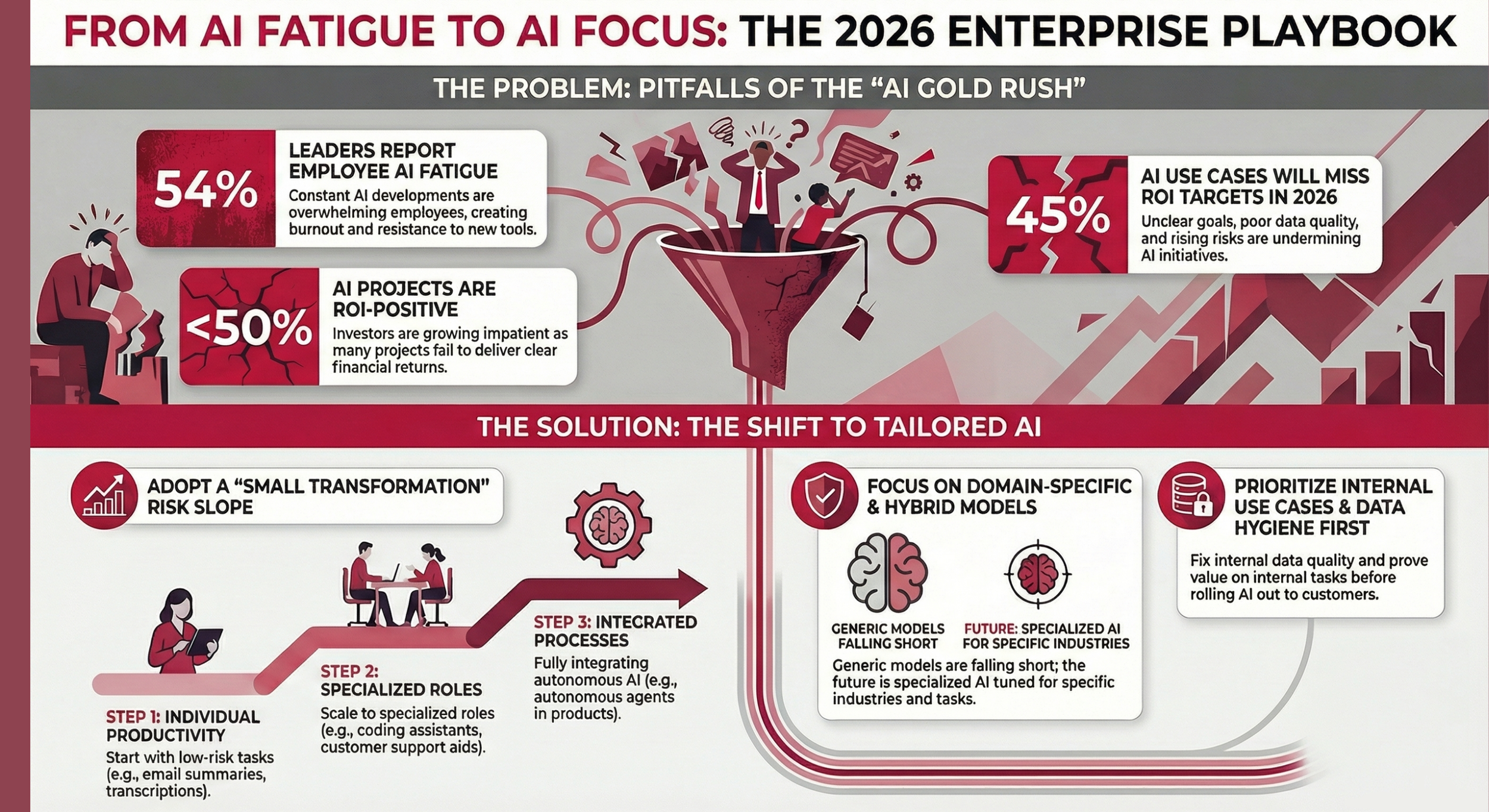
Imperative 1: Mandate a Value-First AI Investment Thesis
Follow PwC's advice to "pick the spots" for AI investment, focusing on high-value workflows that align directly with enterprise priorities. Remember the 80/20 rule: technology delivers only 20% of an initiative's value, while the other 80% comes from redesigning the work itself.
Imperative 2: Architect for Specialization and Autonomy
Build an enterprise AI strategy around specialized Vertical AI and hybrid model ecosystems (LLMs + SLMs) rather than chasing a single, general-purpose "best model." Prioritize agentic AI use cases with a clear and compelling ROI, particularly in areas like revenue operations, supply chain management, and customer service.
Imperative 3: Make Data Quality a C-Suite Priority
Recognize that the "real differentiator is data quality and domain-specific intelligence." Prioritize strategic investment in normalizing and enriching "First-Mile Data"—the unstructured information from customers, partners, and legacy systems—before it ever reaches an AI model.
Imperative 4: Invest Proactively in Your Workforce
Establish essential AI training and upskilling programs immediately, framing this not as a perk but as a survival necessity. As human roles shift from execution to the orchestration and governance of AI agents, a prepared workforce will be your most critical asset.
Imperative 5: Operationalize Governance and Responsible AI
Establish a formal governance framework that treats AI systems like new employees with structured onboarding, ongoing supervision, and defined accountability. Begin preparing now for key regulatory deadlines, including the EU AI Act's August 2026 effective date, and architect for a fragmented global regulatory environment by design.
Imperative 6: Embrace Pragmatic Adoption
Adopt the "small t" transformation approach outlined by MIT Sloan. Climb the risk slope systematically, starting with individual productivity enhancements (Level 1), moving to augmenting specialized roles (Level 2), and finally integrating autonomous systems into core processes (Level 3). This measured approach allows the organization to build capabilities, manage risk, and deliver value at each stage.
Sources
Holland & Knight. (2025, December). What to watch as White House moves to federalize AI regulation. https://www.hklaw.com/
Orrick, Herrington & Sutcliffe LLP. (n.d.). The EU AI Act: 6 steps to take before 2 August 2026. https://www.orrick.com/
Stubbs Alderton & Markiles, LLP. (n.d.). Client alert: New AI laws will prompt changes to how companies do business. https://stubbsalderton.com/
TrustArc. (n.d.). Complying with Colorado's AI law: Your SB24-205 compliance guide. https://trustarc.com/
Verified Credentials. (n.d.). 2026 AI state laws: Regulations in Colorado and California. https://www.verifiedcredentials.com/
AI-Tech Park. (n.d.). The future of AI technology and its impact in 2026. https://ai-techpark.com/
Forrester. (n.d.). Forrester predictions for 2026: AI moves from hype to hard hat work. https://www.forrester.com/
Gartner. (n.d.). Gartner identifies the top strategic technology trends for 2026. https://www.gartner.com/
IDC. (n.d.). Technology & AI predictions | Outlook for Asia-Pacific. https://www.idc.com/
PwC. (n.d.). 2026 AI business predictions. https://www.pwc.com/
Sapphire Ventures. (n.d.). Our 2026 outlook: 10 AI predictions shaping enterprise. https://sapphireventures.com/
DDN. (n.d.). What Gartner's 2026 predictions mean for data-driven enterprises. https://www.ddn.com/
MultiQoS. (n.d.). AI trends every business leader must watch in 2026. https://multiqos.com/
nOps. (n.d.). 25+ stunning FinOps statistics. https://www.nops.io/
TrendForce. (n.d.). AI to reshape the global technology landscape in 2026. https://www.trendforce.com/
HR Executive. (n.d.). The AI in HR dilemma. https://hrexecutive.com/
IDC. (n.d.). Charting the AI-driven future of manufacturing. https://www.idc.com/
TATEEDA | GLOBAL. (n.d.). 2026 AI trends in US healthcare. https://tateeda.com/
Wolters Kluwer. (n.d.). 2026 healthcare AI trends: Insights from experts. https://www.wolterskluwer.com/
Zenskar. (n.d.). Where should CFOs spend their AI finance budget in 2026? https://www.zenskar.com/
Deloitte AI Institute. (n.d.). Agentic enterprise 2028. https://www2.deloitte.com/
Forbes. (n.d.). Leading through AI fatigue. https://www.forbes.com/
Intuition. (n.d.). AI stats every business must know in 2026. https://www.intuition.com/
Webster, M., & Westerman, G. (n.d.). How organizations can achieve big value with smaller AI efforts. MIT Sloan Management Review. https://sloanimr.mit.edu/