
Does a "Made in USA" label really matter to consumers?
A recent research paper by Xinyao Kong and Anita Rao from the University of Chicago Booth School of Business dives into this question, exploring whether this voluntary disclosure actually drives demand or if it's just a marketing gimmick. The study uses a two-pronged approach: analyzing real-world sales data after the Federal Trade Commission (FTC) forced brands to remove deceptive "Made in USA" claims, and conducting a large-scale field experiment on eBay.
Key Findings: The Power of "Made in USA"
The research revealed that the "Made in USA" claim has a significant impact on consumer behavior:
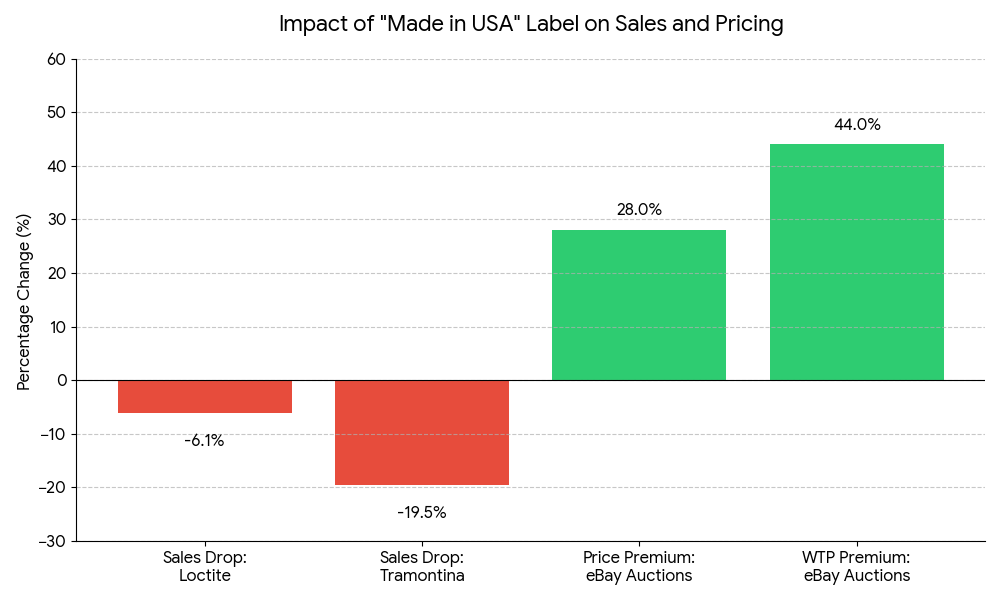
Removal Leads to Sales Slump: When brands were forced by the FTC to remove "Made in USA" claims because they were deceptive, their sales dropped significantly. For instance, Loctite glue saw a 6.1% decline in weekly store sales, while Tramontina cookware experienced a staggering 19.5% drop.
Massive Increase in Willingness-to-Pay: In controlled eBay auctions for screen protectors, products with the "Made in USA" claim saw a 28% higher transaction price on average.
Deep Valuation for Some Consumers: While a tiny fraction of consumers (0.35%) might be put off by the claim, the vast majority who valued it were willing to pay 44% more (an average of 12 cents more on a low-cost item) for the "Made in USA" label.
Identity and Quality Drive Demand: Follow-up surveys indicated that consumers bid more for these products primarily out of support for American firms and workers. The study also found that these bidders were more likely to identify as Republican or hold conservative political views.
The Business Reality: Is Relocation Worth It?
Despite these impressive demand-side numbers, the study offers a reality check for businesses considering moving their manufacturing back to the U.S. solely for this marketing advantage.
Relocation Costs vs. Revenue Gains: The researchers found that the revenue increase from the "Made in USA" claim—estimated at just $29 per 100,000 consumers for the products studied—is likely insufficient to economically justify the massive costs of relocating production from overseas to the U.S..
The Deception Trap: Because the claim is so valuable to consumers but the cost of genuine local production is so high, many firms face a strong incentive to make deceptive claims. However, the FTC is increasingly vigilant, and the study estimates that deceptive claims can account for 1.9% to 19.5% of a firm's revenue—meaning a regulatory crackdown could lead to significant financial loss.
Insights for Your Business Going Forward
How can your business use this information to make better strategic decisions?
Value the Attribute, but Calculate the Cost: The "Made in USA" label is a powerful tool for increasing willingness-to-pay, especially among consumer segments that value national identity and supporting local workers. However, before relocating, perform a rigorous cost-benefit analysis. The premium consumers pay may not cover the increased manufacturing and labor costs.
Accuracy is Non-Negotiable: If you choose to use the "Made in USA" claim, ensure your product is "all or virtually all" made in the U.S.. The FTC's enforcement is real, and the loss of the label can lead to an immediate and significant drop in sales and potential civil penalties.
Know Your Audience: The "Made in USA" claim resonates most strongly with specific demographic and political groups. Tailor your marketing efforts to these segments to maximize the impact of your domestic manufacturing status.
Consider Other Value Propositions: If the cost of domestic manufacturing is too high, focus on other attributes that drive demand—such as quality or environmental sustainability—rather than risking the legal and brand-damage consequences of a deceptive country-of-origin claim.
Conclusion: Navigating the "Made in USA" Advantage
The research by Kong and Rao confirms what many marketers have long suspected: the "Made in USA" label is a potent driver of consumer demand, capable of commanding significant price premiums and fostering deep brand loyalty. However, it also serves as a cautionary tale. The financial gains from the label, while impressive in terms of willingness-to-pay, are often dwarfed by the logistical and operational costs of domestic manufacturing. Furthermore, the legal risks of "Made in USA" mislabeling are higher than ever, with the FTC actively monitoring and penalizing deceptive claims.
For businesses, the path forward isn't about chasing a label at any cost, but about strategic alignment. You must weigh the genuine value your specific customer base places on domestic production against the long-term sustainability of your supply chain.
Source: Kong, X., & Rao, A. (2020, September). Do Made in USA Claims Matter? University of Chicago, Booth School of Business. https://ssrn.com/abstract=3468543